|
| Château de Chambord, Loire Valley, France |
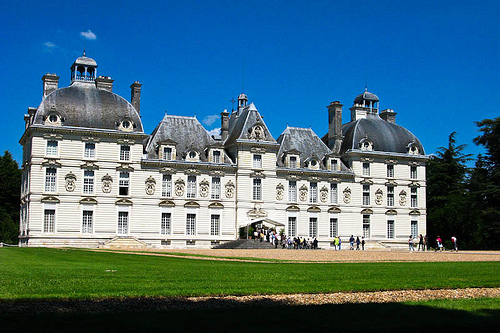
The royal Château de Chambord at Chambord, Loir-et-Cher, France is the largest and most popular of the Loire Châteaux. It’s also one of the most recognizable châteaux in the world because of its very distinct French Renaissance architecture which blends traditional French medieval forms with classical Renaissance structures. The design parallels are north Italian and Leonardesque.
Chambord was built to serve as a hunting lodge for François I, who maintained his royal residences at Château de Blois and Château d’Amboise. Although the original design of the Château de Chambord is attributed, to Domenico da Cortona, some authors claim that the French Renaissance architect Philibert Delorme had a considerable role in the château's design, and others have suggested that Leonardo da Vinci may have designed it.
 |
| Château de Chambord, Loire Valley, France |
The castles distinct French Renaissance architecture combines traditional medieval defensive structures with classical Italian aspects. It dates from the time when chateaux in the Loire no longer needed to have medieval defenses, but elements such as towers and moats were retained for their aesthetic beauty.
The main body of the castle is roughly square in shape, with a large tower in each corner. there are also two (symmetrical) wings to the castle, each also ending with a substantial tower. Bases for a possible further two towers found at the rear, these were never developed, and remain the same height as the wall. Superlatives abound in the immense building and it is said there are more than 400 rooms, and almost as many fireplaces, along with 84 staircases. Four rectangular vaulted hallways on each floor form a cross-shape.
Among all this grandeur, the central staircase still impresses and is perhaps the architectural highlight of a visit. The stone staircase rises the height of Chambord castle, and is of a 'double helix' form. This spectacular double-helix open staircase is the centerpiece of the château. The two helixes ascend the three floors without ever meeting, illuminated from above by a sort of light house at the highest point of the château. There are suggestions that Leonardo da Vinci may have designed the staircase, but this has not been confirmed.
 |
| Château de Chambord, famous double escalier, Loire Valley, France |
The other architectural highlight must surely be the ornate roof, and the feature that makes Chateau de Chambord so instantly recognisable. The roof has often been compared with the skyline of a town. At a glance the roof is symmetrical but look closer and you will see that is not the case - among the numerous towers, light wells and decorative features there are many variations from left to right.
The château also features 128 meters of facade, more than 800 sculpted columns and an elaborately decorated roof. When François I commissioned the construction of Chambord, he wanted it to look like the skyline of Constantinople.
 |
| Château de Chambord, panoramic view, Loire Valley, France |
The result of combining medieval French architecture with highlights from the Italian renaissance might be expected to create an alarming imbalance, but in reality the two combine to create a unified whole that is one of the most notable castles in France.
The design and architecture of the château inspired William Henry Crossland for his design of what is known as the Founder's building at Royal Holloway, University of London. The Founder's building features very similar towers and layout but was built using red bricks.
The Parc de Chambord around the Château is an enormous walled game reserve – the largest in Europe - 52.5‑km² wooded. Wild boars roam freely, though red deer are the beasts you're most likely to spot as they are maintained here. You can explore on foot or by bike or boat – both rentable from the jetty where the Cosson passes alongside the main facade of the Château – and even on horseback, with mounts rented from the Centre Equestre near the Château.
 |
| Château de Chambord, Loire Valley, France |
Who exactly designed Château Chambord is a matter of controversy as we already mentioned. Yet there are proofs that during his stay at Clos Lucé near Amboise, as a guest of François, Leonardo da Vinci is responsible for the original design of the château.
Regardless of who designed the château, in 1519 François Pombriant was ordered to begin construction of Château Chambord.The work was interrupted by The Italian War of 1521–1526 interrupted the work. In September 1526, at which point 1,800 workers were employed building the château. At the time of the death of François in 1547, the work had cost 444,070 livres. The château was built to act as a hunting lodge for Francis, however the king spent barely seven weeks there in total, comprising short hunting visits. The château wasn’t actually practical to live in, as it had been constructed with the purpose of short stays. The massive rooms, open windows and high ceilings meant heating was impractical. In this period the château was barely furnished. There had been used implements brought especially when there was a hunting event.
 |
| Château de Chambord, Loire Valley, France |
After the death of Francois I, the château was abandoned by the French Kings. Thus it was allowed to decay until King Louis XIII gave it to his brother, Gaston d'Orleans in 1639. He started restoration work. King Louis XIV furnished the royal apartments and restored the great keep. There was also added a stable of 1200 horses. That enabled the using of the château to be used as a hunting lodge. So the château was used a few weeks a year. Yet, it was abandoned in 1685.
Later, from 1725 – 1733 King Louis XV lived in Chambord. In 1745 the château was given to Maurice de Saxe as a reward to valour. He used it as a place to his military regiment. The château was abandoned again in 1750 after his death.
After that, during the Revolution, almost everything from the inside of the château – all the furnishings, the wall panellings, even floors was sold and the château stayed abandoned until Napoleon Bonaparte gave it to his subordinate, Louis Alexandre Berthier. Later Chambord was purchased for the Duke of Bordeaux who became Comte de Chambord. His grandfather tried to restore the château but both were exiled in 1830. In 1870 – 1871 Chambord was used as a field hospital during the Franco - Prussian War.
Another attempt of restoration the château was made by the Compte de Chambord but he died in 1883. His sister’s heirs – the Ducal Family from Parma, Italy got Chambord. World War I ended any further attempts to restore it in 1914. The château got confiscated in 1915. In 1939 all the components of the art collections of the Louvre and Compiègne ( including the Mona Lisa and Venus de Milo) were moved here. In 1944 a bomber crashed into the lawn of the château.
Few years after the end of World War II began restoration work. Nowadays château de Chambord is a major tourist attraction as it is the most impressive of all the Châteaux in the Loire Valley.
 |
| Château de Chambord, Loire Valley, France |
 |
| Château de Chambord, inside, Loire Valley, France |
 | |
|